
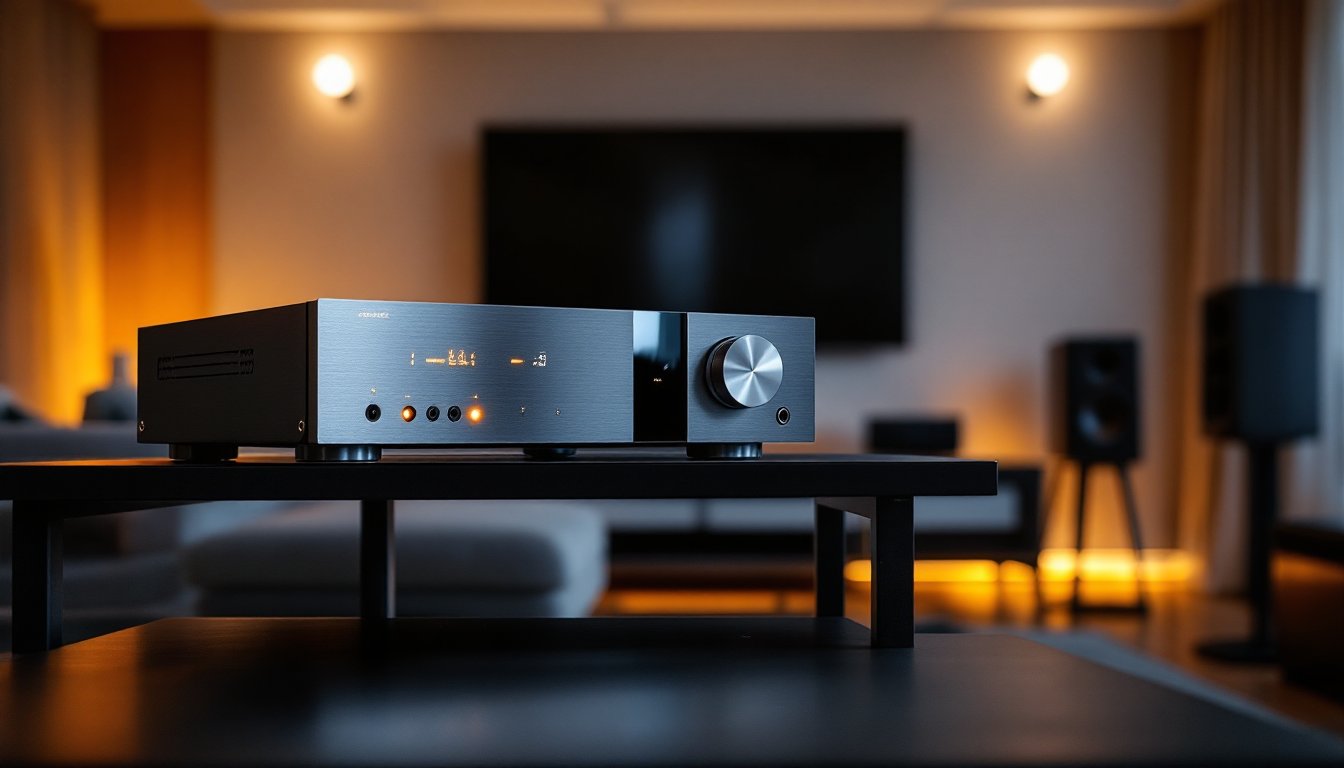
A quality home theater amplifier can transform how you experience movies, music, and games at home, but picking the right one means understanding power, room size, and your actual listening needs. Unlike speakers or AVRs, dedicated amplifiers sit behind the scenes, quietly doing the heavy lifting to deliver clean, powerful audio. This guide walks you through the essential specs, real-world scenarios, and honest setup advice so you can match an amplifier to your space and budget without overspending or underperforming.
Table of Contents
ToggleKey Takeaways
- A dedicated home theater amplifier delivers more power and less distortion than built-in receiver amplifiers, enabling tighter bass, clearer dialogue, and greater dynamic impact in larger rooms or with high-end speakers.
- Match wattage to room size: small rooms need 50–100 watts, medium rooms 100–150 watts, and large rooms 150–300+ watts per channel—always compare RMS continuous power at the same impedance level (8 ohms or 4 ohms).
- Choose the right channel configuration (2, 3, 5, or 7-channel) based on your speaker layout, with 5-channel being the standard workhorse setup for most home theater systems.
- Proper placement with adequate ventilation, balanced XLR cables for runs over 10 feet, and secure speaker connections prevent thermal shutdown and ensure reliable long-term performance.
- Select a best home theater amplifier by first identifying your room dimensions and speaker efficiency rating, then choosing a model that comfortably exceeds your average listening needs without overkill.
Why Choose a Quality Home Theater Amplifier
Your AV receiver includes a built-in amplifier, but dedicated home theater amplifiers are engineered for one job: delivering more power, less distortion, and tighter control over your speakers. Think of it as upgrading from factory speakers to an aftermarket system, you’re not replacing what you have: you’re adding backbone.
When receivers push power limits or drive demanding speakers, they run hot and compress the audio. A separate amplifier lets your receiver focus on switching and processing while the amp handles the grunt work. You’ll notice tighter bass, clearer dialogue, and more dynamic impact during action sequences. This matters most in larger rooms or with high-end speaker systems that demand stable power delivery.
In smaller rooms or with modest speaker setups, a quality receiver alone often suffices. But if you’ve invested in decent speakers or plan to scale your system, a dedicated amp pays dividends. It also future-proofs your setup, you can upgrade speakers without replacing the amp.
Key Specifications to Consider Before Buying
Before you compare model names or prices, nail down the specs that actually matter for your room and speakers.
Wattage and Power Output
Wattage is the starting point, but not the whole story. A 100-watt amplifier rated at 8 ohms delivers 100 watts per channel into a standard speaker load. At 4 ohms, a lower impedance that demands more current, that same amp might deliver 150 watts or more. Check the spec sheet for both figures: they tell you how hard the amp will push your speakers.
For room sizing: A small room (under 200 square feet) with moderate speakers typically needs 50–100 watts per channel. A medium room (200–400 sq ft) runs comfortably with 100–150 watts. A large room (over 400 sq ft) with demanding speakers benefits from 150–300+ watts. These are guidelines, not laws, speaker efficiency and room acoustics matter as much as raw wattage.
Don’t confuse peak power with continuous power. Peak ratings are brief spikes: continuous RMS power (root mean square) is what you live with daily. Always compare RMS specs at the same impedance level.
Channels and Connectivity Options
Most home theater amps come in 2-channel (stereo), 3-channel, 5-channel, or 7-channel configurations. A 5-channel amp handles left front, center, and right front channels plus two surrounds, the workhorse setup. Want to add back surround heights or extra mains? Step up to 7 channels.
Connectivity matters too. Look for balanced XLR inputs (preferred for longer runs and noise rejection) or unbalanced RCA inputs. Some amps include pre-out loops for subwoofers or outboard processors. If you’re running long cable runs from your receiver to amplifier, say, 50 feet or more, balanced XLR connections reduce noise and hum.
Thermally, larger amps need adequate ventilation. A 200-watt amp in a tight cabinet runs hotter than a 75-watt model. Plan your placement before buying: amps driven hard in enclosed spaces overheat and shut down mid-movie.
Top-Rated Amplifiers for Different Room Sizes
Room size and speaker efficiency should guide your shopping. Here’s how to think about it:
Small rooms and efficient speakers (25–75 sq meters, speakers rated 87 dB or higher) work fine with 50–75 watt compact amps. These sit easily on shelves, run cool, and cost under $500. Ideal if you’ve got a tight media closet or bookshelf setup.
Medium rooms and standard speakers (75–150 sq meters, 85–87 dB efficient) thrive on 100–150 watt 3- or 5-channel amps. This is the sweet spot for most home theater builds. You get enough grunt for dynamic action scenes without overkill. Prices range from $600 to $1,500.
Large rooms and demanding speakers (150+ sq meters, below 85 dB efficient) need 200–400 watt class amps. Some audiophiles use multiple amps (one for mains, one for surrounds) to distribute the load and reduce heat. Expect $1,500 to $4,000+. Dedicated home theater amplifiers in this class often use class D or class AB topologies for efficiency.
When shopping, read reviews that mention your speaker brand, different speakers load differently. A set of speakers that reviewer tested might tell you exactly how an amp performs in your scenario. The best AV receivers for 2024 often pair well with specific amp classes, so cross-reference.
Installation and Setup Tips for Homeowners
Installing a home theater amplifier is straightforward if you respect a few rules.
Placement & Ventilation: Position your amp in a well-ventilated spot, ideally open shelving or a rack with airflow behind and above it. Don’t stack it under or over hot gear. Leave at least 4 inches of clearance on all sides if mounted in an enclosed cabinet. Amps need to breathe: poor airflow causes thermal shutdown and shortens component life.
Cable Runs: Use quality, shielded interconnect cables from your receiver’s pre-out (or output) to the amp’s inputs. For runs under 10 feet, standard RCA cables suffice. Beyond 10 feet, upgrade to balanced XLR interconnects, they reject noise and hum far better. Keep audio cables away from power cables to avoid interference. If you must cross, do so at 90 degrees.
Speaker Connections: Most amps use bare-wire binding posts or banana plug connectors. Strip about 0.5 inches of insulation from speaker wire, twist the strands, and insert into the post or banana jack. Loose connections introduce noise and reduce power transfer. If your amp has adjustable output impedance settings, consult the manual, some amps let you optimize for 4-ohm or 8-ohm loads.
Power & Grounding: Run your amp on its own dedicated circuit if possible, away from high-draw appliances. Some installers add a ground lift switch if you hear hum, it isolates the ground between receiver and amp. Never skip the amp’s power cable: cheap power cords introduce noise and risk fire.
Once hooked up, let the amp warm up for 10 minutes before pushing it hard. Most home theater amplifiers in 2024 use thermal protection circuits, but gradual warm-up is kinder to components. Run a test tone at moderate volume and listen for channel balance. If one side sounds quieter, check your speaker impedance and cable connections. For complex setups involving multiple amps or long runs, professional installation pays for itself in peace of mind and warranty support.
Conclusion
Choosing the right home theater amplifier comes down to matching wattage and channels to your room size, speaker efficiency, and budget. Start with your room dimensions and speaker specs, then choose an amp that comfortably exceeds your average listening needs, you’re not buying the biggest amp on the shelf, but one that works without strain. Proper ventilation, quality interconnects, and correct speaker impedance matching ensure years of reliable performance. Resources like top AV receivers for home theater offer detailed comparisons if you’re torn between models. Take your time, match the specs to your space, and you’ll hear the difference.